Nedmag calcium chloride prills offer a reliable and high-performance solution that delivers clear advantages over calcium chloride flakes in many practical applications. Their consistent quality, predictable behavior and ease of use make prills an attractive option for customers focused on efficiency, safety and cost effectiveness.
This page outlines the key performance differences between calcium chloride prills and calcium chloride flakes, with a focus on product composition, handling characteristics, temperature development during dissolution and water absorption behavior. These parameters play an important role in operational performance and overall process reliability.
Compared to flakes, calcium chloride prills provide benefits such as faster and more uniform solubility, improved flowability, reduced dust formation and enhanced storage stability. In addition, prills can offer logistical and economic advantages through better availability, with a competitive price position resulting from higher active CaCl₂ loading per tonne, reducing logistics cost compared to flakes.
Nedmag’s calcium chloride prills are sourced from the European Zechstein Sea, ensuring short supply chains, consistent availability and full compliance with applicable European legislation and standards. Nedmag operates within a reliable quality and safety framework and is certified according to ISO9001, ISO14001, REACH, FSSC22000 and GMP+. In our values, we take responsibility for our impact on people, society and the environment, place ethical conduct at the center of our actions and make sustainable choices throughout the entire value chain, in line with internationally accepted codes of conduct.
| Nedmag 94–97 % CaCl₂ Prills | Generic 77 % CaCl₂ Flakes |
| Water free formulation. One ton of product delivers one full ton of active calcium chloride | Contains approximately 20% crystal water, resulting in only 770 kg of active calcium chloride per ton of product |
| Transparent pricing. The price per ton of CaCl₂ equals the price per ton of product | Higher effective cost. The price per ton of CaCl₂ is approximately 25% higher than the price per ton of product |
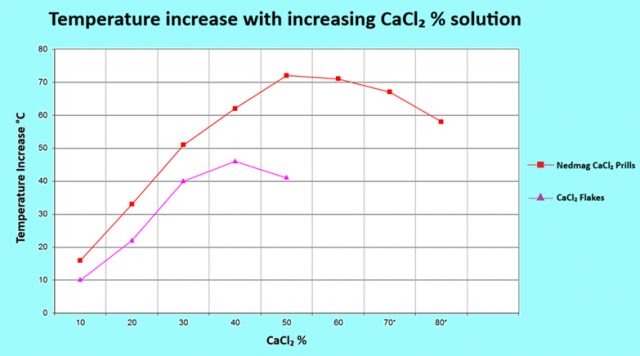
| High heat release when dissolving, enabling fast and effective performance | Lower temperature increase upon dissolving compared to prills, resulting in slower heat release |
| Fast dissolving thanks to the porous structure, reducing preparation time | Slower dissolving performance. Flakes tend to settle in water and require additional stirring to dissolve properly |
| Excellent flowability, suitable for pneumatic conveying and hose blowing | Flakes have poor flowing characteristics |
| Suitable for bulk storage, enabling efficient logistics | Bulk storage is challenging due to moisture sensitivity and caking risks |
| Very high absorption capacity. Absorbs its own weight in water (1 kg water per kg product) | Moderate absorption capacity. Absorbs up to 60% of its own weight in water (0,6 kg water per kg product) |
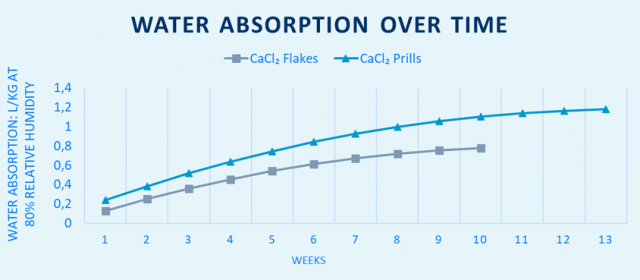
The following graphs illustrate the key performance differences between calcium chloride prills and flakes. The temperature increase graph shows the heat release during dissolution at increasing CaCl₂ concentrations, while the water absorption graph highlights the moisture uptake behavior over time.
Together, these graphs support a direct comparison of efficiency, handling performance and functional effectiveness of prills versus flakes in practical applications.